
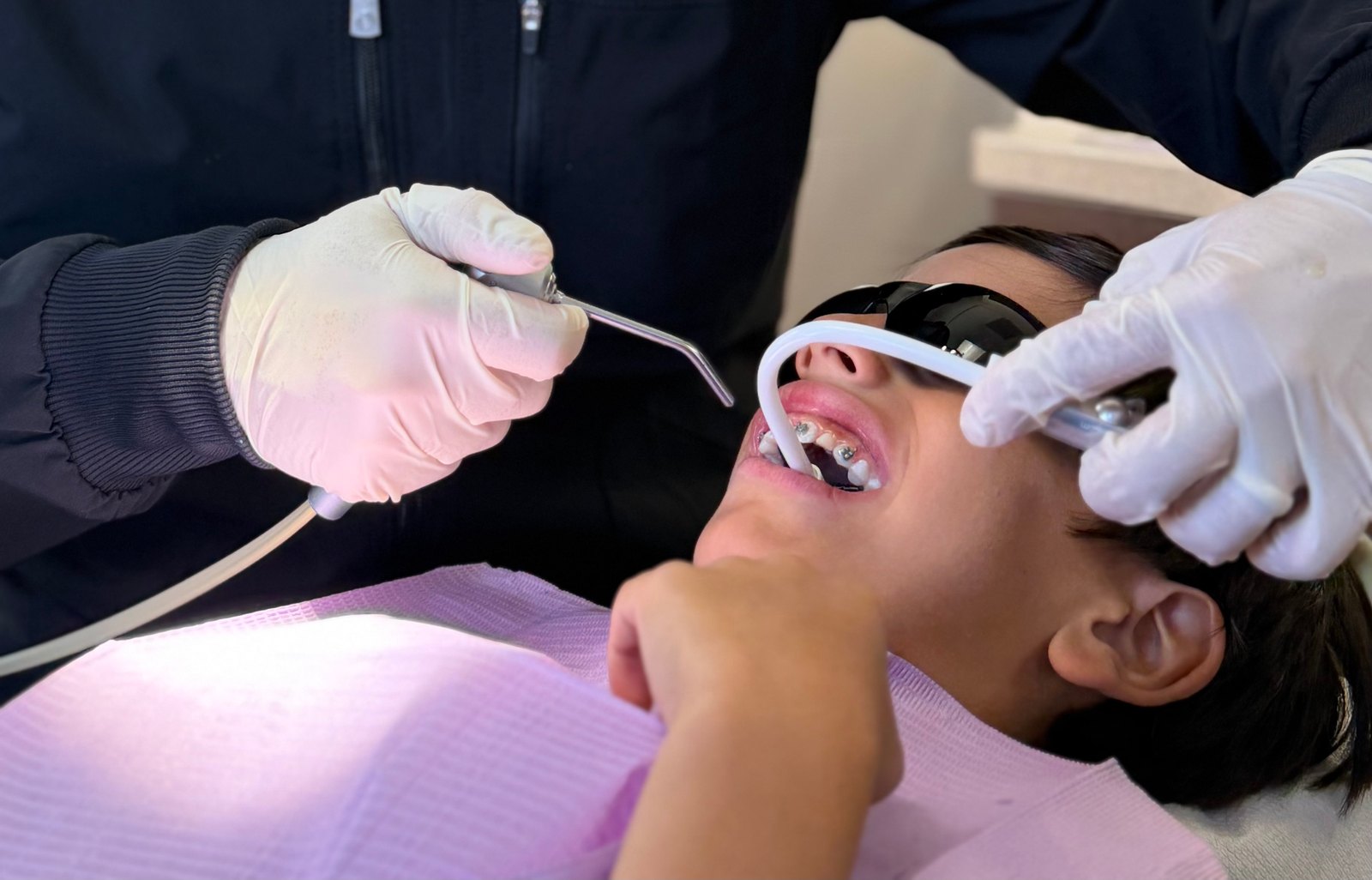
Age 7 is the right time for your child’s first orthodontic checkup, even when their smile looks fine. At this age, an orthodontist can see how the teeth and jaws are developing and decide whether anything needs attention now, later, or not at all. If you notice a concern before age 7, schedule the visit sooner.
Why age 7?
The American Association of Orthodontists (AAO) recommends a first orthodontic checkup when a problem is noticed, and no later than age 7. Seven is the right milestone because most children then have a mix of baby and permanent teeth. That gives an orthodontist an opportunity to assess the bite, jaw growth, and how permanent teeth are coming in—even when a concern is not obvious at home.[1]
This does not replace regular dental visits. The American Dental Association (ADA) recommends a child’s first dental visit after the first tooth appears and no later than the first birthday. The ADA also notes that abnormal bites commonly become noticeable between ages 6 and 12. Your child’s dentist and orthodontist can work together as their smile develops.[2][3]
What can an early visit reveal?
An orthodontist can look for crossbites, an underbite, a jaw that shifts when your child bites, significant crowding or spacing, and permanent teeth erupting in unexpected positions. The visit also gives you a chance to discuss chewing concerns, early or late loss of baby teeth, and habits that may affect the bite.[1]
The exam starts with a conversation and a look at the teeth and bite. If additional records or X-rays would help answer a specific clinical question, the orthodontist can explain why they are recommended.
Sometimes the timing of treatment matters
A checkup can identify a specific problem that may benefit from treatment while a child still has baby teeth. For example, a randomized trial in the American Journal of Orthodontics and Dentofacial Orthopedics (AJODO) found that a unilateral posterior crossbite in the mixed dentition did not correct itself in its untreated group; one appliance successfully corrected many of the treated cases. That finding applies to children with that diagnosed bite problem, not to every child.[4]
Another AJODO randomized trial studied children ages 7.6 to 9.6 with palatally displaced upper canines. In that selected group, early expansion increased the rate at which those permanent canines erupted compared with no treatment. This is one example of why spotting an eruption concern early can matter; it is not a reason to expand every child’s palate.[5]
An early checkup does not mean early braces
Many children need only observation while more permanent teeth come in. The orthodontist may recommend a future check, treatment at a later age, or no treatment at all. A study in AJODO comparing early two-phase treatment with later one-phase treatment for a particular Class II bite problem found little difference in final outcomes after both groups completed treatment. Starting earlier is not automatically better for every condition.[6]
The purpose of the age-7 visit is to get the timing right for your child—not to start braces on their seventh birthday.
When should you come sooner?
If you notice a crossbite, a jaw shift, trouble biting or chewing, unusual crowding, or a permanent tooth coming in far from where you expected, ask for an orthodontic evaluation before age 7. You do not need to wait for a referral. If your child is already older than 7, a first visit is still worthwhile.[1]
At Colorado Braces, we can assess your child’s developing bite, explain what we see, and recommend the right next step—whether that is treatment, monitoring, or reassurance.
Recommendations and scientific references
Professional recommendations
- [1]AAO: The Right Time—When Should Your Child See an Orthodontist?
- [2]ADA: Your Baby’s First Dental Visit
- [3]ADA: Braces
Scientific studies
- [4]Petrén S, Bondemark L. Correction of unilateral posterior crossbite in the mixed dentition: a randomized controlled trial. AJODO. 2008;133:790.e7–e13.
- [5]Baccetti T, Mucedero M, Leonardi M, Cozza P. Interceptive treatment of palatal impaction of maxillary canines with rapid maxillary expansion: a randomized clinical trial. AJODO. 2009;136:657–661.
- [6]Tulloch JFC, Proffit WR, Phillips C. Outcomes in a 2-phase randomized clinical trial of early Class II treatment. AJODO. 2004;125:657–667.